
Beyond the Junkyard: The Lifecycle of a Scrap Car in 2026
A Homeowner’s Guide to Economics, Ecology, and Efficiency
Most people see an old car as “junk” taking up space. In reality, that vehicle is a dormant goldmine of industrial raw materials and specialized components. In 2026, the “scrap” industry has evolved into a sophisticated circular economy that balances financial return with environmental stewardship.
If you have a vehicle reaching its “End-of-Life” (ELV), here is everything you need to know to make an informed, profitable decision.
When Does a Car Become “Scrap”?
It’s a common misconception that a car must be totaled to be considered scrap. Economically, a vehicle enters the scrap category when its Total Cost of Ownership (TCO) exceeds its utility.
• The “Repair Ceiling”: When a single repair (like a head gasket or transmission) costs more than 60–70% of the car’s resale value.
• Structural Integrity: Advanced rust or frame damage that compromises safety in a collision.
• The “Ghost” Factor: Vehicles that have sat idle for over six months, leading to dry-rotted tires, seized brakes, and degraded fuel systems.
• Technological Obsolescence: Older internal combustion engines (ICE) that no longer meet modern emission standards or fuel efficiency needs.
The Math Behind the Offer
When a professional buyer gives you a quote, they aren’t guessing. They are calculating a formula based on Live Market Data:
1. Curb Weight: The base price is set by the “price per ton” of HMS (Heavy Melting Steel).
2. Parts Demand: If your car model is common, the resale value of its doors, lights, and mirrors increases.
3. The “Precious” Premium: The specific year/make/model determines the size and value of the catalytic converter.
4. Logistics: The proximity of your location (e.g., Aurora vs. Newmarket) to the shredding facility affects towing overhead.
The 5-Step Green Transformation
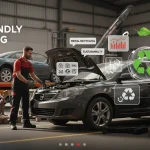
The days of “dumping” cars are over. Modern recycling follows a strict environmental protocol:
1. De-pollution
This is the most critical step. Technicians extract “Hazardous Fluids” including engine oil, coolant, brake fluid, and refrigerant. In 2026, these are processed for re-refinement rather than just disposal.
2. High-Value Dismantling
Components that can be reused (alternators, starters, body panels) are cataloged and sold to secondary markets, extending the life of other vehicles on the road.
3. Media Separation (The Shredder)
The remaining shell is fed into a massive shredder. Magnets pull out ferrous metals (iron/steel), while “eddy current separators” use physics to pop out non-ferrous metals (aluminum/copper).
4. Fluff Management
Non-metallic materials (plastics, foam, glass) are sorted. Advancements now allow a high percentage of “auto-shredder residue” to be repurposed into industrial insulation or fuel.
5. The New Beginning
The purified metal is melted down and sent back to manufacturers. Your 2012 sedan might eventually become part of a 2027 EV chassis.
Local Impact: Aurora & Newmarket
In the GTA, environmental regulations are tightening. Leaving an ELV on your property isn’t just an eyesore; it’s a liability.
• Property Value: A clean driveway instantly boosts curb appeal.
• Soil Health: Preventing fluid seepage protects the local water table in our suburban communities.
Final Thoughts
Scrapping a car is the final act of responsible ownership. It’s the moment you stop paying for a liability and start contributing to a sustainable manufacturing cycle.